Table of Contents
- How Hyperbaric Oxygen Therapy Works for Sports Recovery
- Hyperbaric Oxygen Therapy for Sports Injuries: What the Evidence Shows
- Hyperbaric Oxygen Therapy for Athletes: DOMS, Inflammation, and Recovery Time
- Hyperbaric Oxygen Therapy Session Length and Treatment Protocols
- Hyperbaric Oxygen Therapy Side Effects and Safety Considerations
- Who Qualifies for HBOT and When to Consult a Sports Medicine Clinician
- HBOT Compared to Standard Recovery Approaches
- Frequently Asked Questions
Last Updated: October 15, 2026
How Hyperbaric Oxygen Therapy Works for Sports Recovery
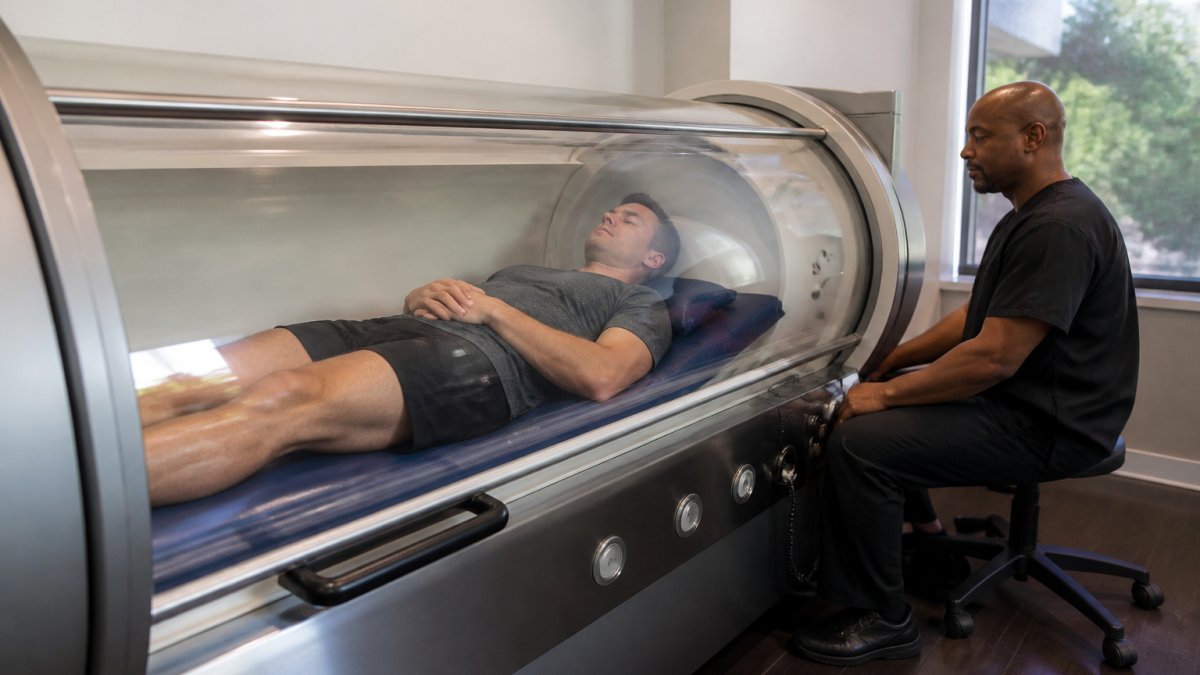
Hyperbaric oxygen therapy for sports recovery is a treatment in which an athlete breathes pure oxygen inside a pressurized chamber, raising the amount of oxygen dissolved in the blood so more of it can reach injured tissue. At Campbell Chiropractic Wellness, we explain it to patients this way: the chamber does not heal the injury, it changes the environment around it.
The core mechanism is straightforward. Under increased pressure, oxygen dissolves directly into plasma rather than riding only on red blood cells. That extra oxygen travels to areas where blood flow has been disrupted by swelling or damaged capillaries, supporting the tissue repair process that follows a muscle injury, ligament sprain, or tendon injury.
Oxygen Delivery, Blood Flow, and Tissue Repair
Injured tissue is often starved of oxygen at the exact moment it needs it most. Inflammation and swelling compress small blood vessels, so nutrient delivery slows just as cellular repair accelerates. Pressure increases oxygen delivery to those compromised areas, which is the proposed reason athletes report benefits.
That is the theory. What the evidence actually supports is narrower, and we cover that next.
Hyperbaric Oxygen Therapy for Sports Injuries: What the Evidence Shows
The evidence for hyperbaric oxygen therapy for sports injuries is mixed, and the reason is structural rather than accidental. Most clinical study data comes from wound healing, crush injuries, and compromised flaps or grafts, not from healthy athletes with a hamstring strain. When a clinic cites “studies show,” it is usually extrapolating from a different population with a different problem.
That distinction matters because the regulatory and reimbursement picture is built on it.
Established Indications vs. Investigational Athletic Use
The Undersea and Hyperbaric Medical Society’s approved indications list covers conditions such as diabetic foot ulcers, delayed radiation injury, compromised skin grafts, and crush injury with traumatic ischemia. Routine athletic injury is not on it. The FDA’s consumer information on hyperbaric oxygen therapy draws the same line: cleared uses are specific medical conditions, and use outside those cleared indications is considered off-label or investigational.
For an athlete, that means three practical things:
- A provider marketing HBOT for recovery is describing off-label use. That is not automatically wrong, but it should be disclosed.
- Insurance generally will not cover off-label athletic recovery. Coverage decisions follow the cleared indications, not the marketing.
- “Investigational” is not the same as “proven.” It means the question is still open.
Why the Evidence Base Looks Uneven
Different tissues recover on different timelines, and HBOT research reflects that unevenly.
- Muscle injury: Small studies suggest reduced swelling and pain, but sample sizes are usually tiny and control groups vary. A common pattern in this literature is a positive signal that does not survive replication at scale.
- Ligament sprain: Evidence is thin. Standard rehabilitation, protected loading, proprioceptive work, graded return, remains the foundation, and no HBOT study has displaced it.
- Tendon injury: Chronic overuse injury responds slowly regardless of therapy, and HBOT data here is the weakest of the three. Tendon healing is limited by poor vascularity, which is precisely the problem HBOT is proposed to solve, yet the clinical results have not matched the mechanism.
- DOMS and post-training recovery: Covered in the next section, but the short version is that no strong randomized controlled trial shows HBOT reliably shortens the soreness window in trained athletes.
How to Read an HBOT Study Claim
When you see a study cited in support of HBOT for sports recovery, four questions separate signal from marketing:
- Who was studied? Healthy athletes, or patients with a wound or crush injury?
- What was the comparator? Sham chamber, standard rehab, or nothing?
- What was measured? A biomarker, a pain score, or an actual return-to-play date?
- How many participants? Small samples produce dramatic-looking results that often do not hold.
HBOT has established medical indications and an investigational frontier. Athletic recovery sits on the investigational side. That does not make it useless, it makes it unproven, and it means the burden is on the provider to explain what is known and what is not.
Hyperbaric Oxygen Therapy for Athletes: DOMS, Inflammation, and Recovery Time
Delayed-onset muscle soreness, or DOMS, is the ache that peaks a day or two after eccentric exercise such as downhill running or heavy negatives. It is not the same as an acute injury, and it resolves on its own.
Some athletes use HBOT hoping to shorten that window. There is no strong randomized controlled trial showing it reliably does. Inflammation is a normal part of adaptation; blunting it entirely may not help performance.
Treating DOMS with HBOT instead of rest, hydration, and progressive loading can delay return to play. The soreness is a signal, not a problem to suppress.
Hyperbaric Oxygen Therapy Session Length and Treatment Protocols
The typical hyperbaric oxygen therapy session length runs 60 to 90 minutes at pressures between 1.5 and 2.5 atmospheres. Protocols vary widely by provider, and no single schedule is standard for athletic recovery.
A common approach is a short block of sessions over one to two weeks, then reassessment. Ask any provider three questions before booking:
- What pressure and duration will you use?
- How many sessions before we evaluate progress?
- What outcome are we measuring?
Book a reassessment point in advance. If there is no measurable change by session five, more sessions rarely change the picture.
Hyperbaric Oxygen Therapy Side Effects and Safety Considerations
Hyperbaric oxygen therapy side effects are usually mild but real. Ear pressure and discomfort from barotrauma are the most common complaints, and they are manageable with equalization techniques taught before the first session.
Less common risks include temporary vision changes, sinus pain, and, rarely, oxygen toxicity. Seizure from oxygen toxicity is uncommon at standard therapeutic pressures but is why medical supervision matters.
| Concern | How Common | What Reduces Risk |
|---|---|---|
| Ear pressure | Most common | Equalization training before session |
| Sinus pain | Occasional | Screening for congestion or colds |
| Vision changes | Uncommon | Usually temporary, resolves after treatment |
| Oxygen toxicity | Rare | Proper pressure limits and supervision |
Who Qualifies for HBOT and When to Consult a Sports Medicine Clinician
Not every athlete is a candidate. A sports medicine clinician should evaluate the injury first, because HBOT is an adjunct, not a diagnosis.
Contraindications include untreated pneumothorax and certain lung conditions. Anyone with a history of ear surgery, seizures, or claustrophobia should discuss it with a physician first. The FDA’s consumer information on hyperbaric oxygen therapy notes that chamber use outside cleared indications carries risks without proven benefit.
HBOT Compared to Standard Recovery Approaches
Standard rehabilitation remains the foundation: load management, physiotherapy, and graded return to activity. HBOT is best understood as a possible add-on for specific cases, not a replacement. But the comparison most athletes actually need is not clinical, it is practical. What does each option cost, what does it require of your time, and what does the evidence say it delivers?
A Practical Comparison
| Approach | Typical Cost (USD) | Time Commitment | Evidence Strength for Athletic Recovery |
|---|---|---|---|
| Sleep, nutrition, progressive loading | No direct cost | Ongoing, built into training | Strong, foundational across sports medicine |
| Physiotherapy / sports rehab | Varies widely by market and visit length | Weeks to months, scheduled visits | Strong for most musculoskeletal injuries |
| HBOT (off-label athletic use) | Per-session fees set by the provider; multi-session blocks add up quickly | 60-90 minutes per session, often daily for 1-2 weeks | Weak to investigational for athletic recovery |
HBOT pricing is not standardized. Chambers, staffing, and medical supervision all drive the per-session fee, and a block of sessions can run into four figures. Because off-label athletic recovery is not a covered indication, most health plans will not reimburse it, and you should confirm coverage in writing before booking rather than assuming a superbill will be accepted.
Access and Logistics
HBOT is not available everywhere. Monoplace and multiplace chambers are concentrated in hospital wound-care centers, some orthopedic and sports medicine practices, and standalone clinics. That means access often depends on geography, and a course of treatment can mean daily travel for one to two weeks, a real cost that does not show up in the per-session price.
When HBOT Might Be Worth Discussing
HBOT is most defensible as an adjunct when a clinician identifies a specific problem it is designed to address, compromised tissue oxygenation, a wound that is not healing, or a crush-type injury. For routine soreness, a hamstring strain, or a sprained ankle, the highest-return investments remain sleep, protein intake, and structured rehabilitation.
Before committing to a block of sessions, ask the provider for a written estimate of total cost, a stated reassessment point, and the specific outcome being measured. If any of those three is vague, that is your answer.
The Bottom Line
HBOT may help in select situations, but it is not a shortcut around the basics, and it is not a substitute for diagnosis. If you are weighing it, start with a sports medicine clinician who can confirm what is actually injured, then decide whether an unproven add-on is worth the cost and time on top of a rehab plan that already works.
Frequently Asked Questions
Does hyperbaric oxygen therapy help with sports recovery?
Research suggests HBOT may support sports recovery by increasing oxygen delivery to injured tissues, reducing inflammation and swelling, and promoting tissue repair. However, evidence quality varies. Some clinical studies show faster return to activity, while others report limited benefit. HBOT is not a guaranteed fix, and results depend on injury type, treatment protocol, and overall rehabilitation plan. Athletes should treat it as one part of a broader recovery strategy that includes physical therapy and proper rest.
How many hyperbaric oxygen therapy sessions do athletes need?
The number of sessions varies by injury and protocol. Some athletes undergo 5 to 10 sessions for acute injuries, while chronic conditions may require 20 or more. Session frequency typically ranges from once daily to twice daily, depending on the treatment plan. A sports medicine clinician or HBOT provider can recommend a schedule based on your specific injury, recovery goals, and how your body responds. More sessions do not always mean better results.
How long does a hyperbaric oxygen therapy session last?
Most hyperbaric oxygen therapy sessions last between 60 and 120 minutes. The session length depends on the pressure used and the condition being treated. Some protocols for sports injuries use lower pressure and shorter sessions, while others follow standard clinical protocols. You should factor in time for preparation, pressurization, and depressurization. Your provider will explain the expected duration before treatment begins.
Is hyperbaric oxygen therapy safe for athletes?
HBOT is generally well tolerated when administered by qualified professionals in a clinical setting. Common side effects include ear pressure or discomfort, similar to what you feel on an airplane. More serious risks, such as oxygen toxicity or pneumothorax, are rare but possible. Certain conditions, including untreated pneumothorax and some lung diseases, make HBOT unsafe. Always disclose your full medical history and consult a sports medicine clinician before starting treatment.
What are the side effects of hyperbaric oxygen therapy?
The most common side effects of hyperbaric oxygen therapy are ear pressure, sinus discomfort, and temporary vision changes. These usually resolve after treatment ends. Less common effects include fatigue, headache, and claustrophobia inside the chamber. Serious complications like oxygen toxicity and barotrauma are rare when protocols are followed correctly. Tell your provider about any discomfort during or after sessions so they can adjust the treatment if needed.
Can hyperbaric oxygen therapy speed up muscle recovery after exercise?
Some research suggests HBOT may reduce delayed-onset muscle soreness (DOMS) and markers of muscle damage after intense eccentric exercise. Studies on quadriceps strength and muscle function show mixed results. Some athletes report faster recovery, but evidence is not consistent enough to promise a specific outcome. HBOT may complement training recovery strategies like sleep, nutrition, and active recovery, but it should not replace them.
Recovering from a sports injury takes a plan, not a single treatment. At Campbell Chiropractic Wellness, we combine chiropractic care, spinal decompression therapy, and specialized therapies such as hyperbaric oxygen and cold laser therapy to support rehabilitation at every stage. Our team cares for patients of all ages, from pediatric to senior, and we are accepting new appointments. Request an appointment with Campbell Chiropractic Wellness and build a recovery plan that fits your sport.
