Last Updated: November 14, 2026
Quick Summary
Manual therapy for neck tension is a hands-on treatment in which a trained clinician uses controlled pressure, stretching, and joint movement to ease tight muscles and stiff joints in the neck. It is often paired with exercise and self-care, and research suggests it can help with pain, range of motion, and function, especially when combined with exercise rather than used alone.
- Cervical techniques fall into two groups: joint techniques and soft-tissue techniques, and most plans combine both.
- A 2024 umbrella review in PubMed Central reported manual therapy may reduce pain and improve range of motion and function.
- Short-term relief is the most consistent finding; lasting change depends on what you do between visits.
- Chin tucks, neck turns, shoulder rolls, and an upper trap stretch are simple exercises to pair with hands-on care.
- Stop and tell your clinician if a technique causes sharp pain, dizziness, or new arm symptoms.
Table of Contents
- What Manual Therapy for Neck Tension Involves
- Cervical Manual Therapy Techniques Used in Practice
- What the Evidence Says About Manual Therapy for Neck Pain
- Manual Therapy vs Exercise for Neck Pain
- Exercises for Mechanical Neck Disorders to Pair With Hands-On Care
- When Cervicothoracic Junction Pain Needs a Closer Look
- Safety, Warning Signs, and What a Visit Looks Like
- Booking Your Neck Tension Assessment
- Frequently Asked Questions
What Manual Therapy for Neck Tension Involves
Manual therapy for neck tension is a hands-on treatment approach in which a trained clinician uses controlled pressure, stretching, and joint movement to ease tight muscles and stiff joints in the neck.
The goal is simple: reduce muscle tension, restore movement, and help you feel better in daily life.
Most people with neck tension describe:
- A dull ache at the base of the skull
- Tightness that builds through the workday
- Stiffness when turning the head
- Headaches that start in the neck
Neck pain is common. According to clinical practice guidelines in the Journal of Orthopaedic & Sports Physical Therapy, the one-year incidence of neck pain ranges from 10.4% to 21.3%.
Manual therapy is not a single technique. It is a group of hands-on methods, and a clinician picks the ones that fit your exam findings.
Cervical Manual Therapy Techniques Used in Practice
Cervical manual therapy techniques fall into two main groups: joint techniques and soft-tissue techniques. Most treatment plans combine both.
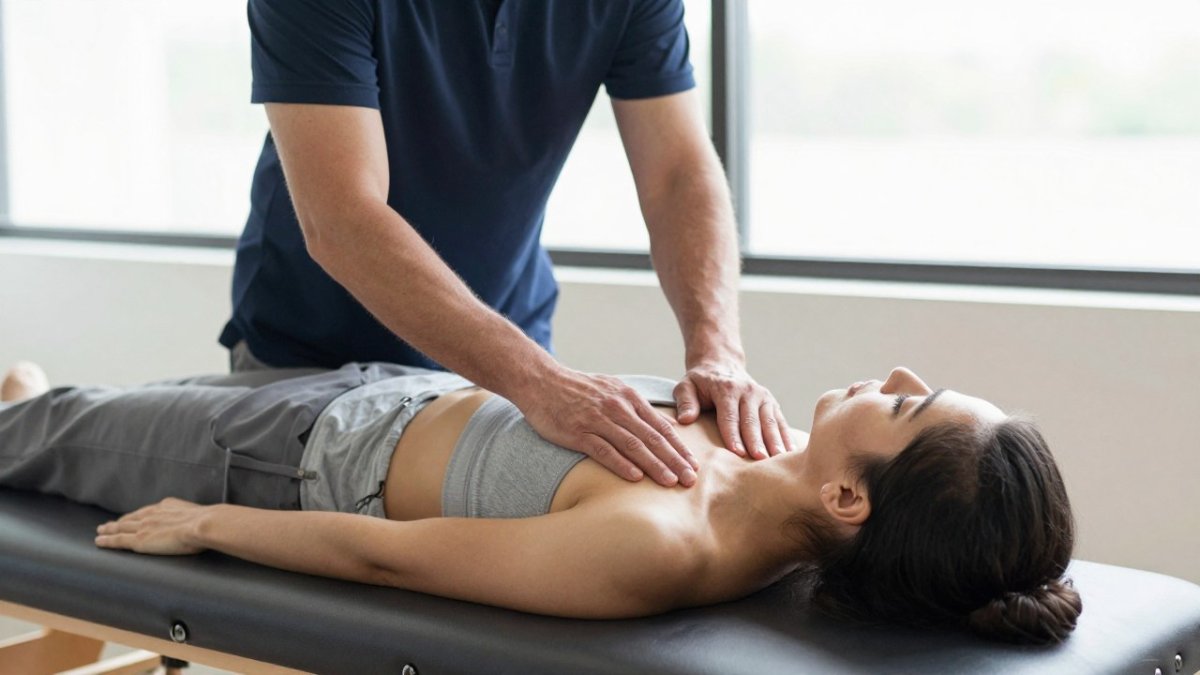
Here is how we think about the main options:
| Technique | What It Does | Typically Used For |
|---|---|---|
| Joint mobilization | Slow, graded movement of a stiff joint | Restricted range of motion |
| Spinal manipulation | A quick, controlled thrust | Stubborn joint stiffness |
| Soft-tissue work | Pressure on tight muscles | Muscle tension and trigger points |
| Massage | Broader muscle relaxation | General tightness and stress |
For readers who want to see our hands-on chiropractic care in more detail, you can explore our chiropractic care.
Joint Mobilization and Spinal Manipulation
Joint mobilization uses slow, repeated movements to improve how a cervical spine joint glides. Spinal manipulation applies a quick, controlled push to restore motion. Both target joint stiffness, not just muscle tightness.
These techniques are not one-size-fits-all. A clinician checks your history and exam first, then decides what is appropriate. If you want to understand the adjustment side of care, you can review our gentle spinal manipulation and browse our chiropractic adjustments.
Soft-Tissue Work and Massage
Soft-tissue work applies focused pressure to tight bands of muscle. Massage covers a broader area to ease overall tension. Both can improve blood flow and help muscles relax.
Many patients pair soft-tissue work with joint techniques in the same visit. The combination often feels more complete than either method alone.
What the Evidence Says About Manual Therapy for Neck Pain
The evidence is encouraging but not a cure-all.
A 2024 umbrella review in PubMed Central reported that manual therapy may contribute to pain reduction, improved range of motion, and better functional outcomes for people with neck disorders.
Here is how to read those findings for neck tension specifically:
- Tension-pattern neck pain is often classified as mechanical or nonspecific neck pain. That is the category most of these studies enroll, which is why the results are relevant to you rather than to people with fracture, infection, or nerve-root compression.
- The strongest signal is for combined care. Reviews that pair hands-on treatment with exercise tend to report better pain and function outcomes than either approach alone, which is why a good plan does not stop at the treatment table.
- Short-term relief is the most consistent finding. Improvements in pain and range of motion show up in the first few weeks; lasting change depends on what you do between visits.
- Effect sizes vary by technique and by patient. A quick thrust manipulation and a gentle mobilization are not interchangeable, and a clinician should match the technique to your exam findings rather than to a favorite method.
Patients with arm numbness, tingling, or weakness need a different evaluation path, which is covered in the safety section below.
What the research does not support is the idea that more hands-on treatment is always better.
Manual Therapy vs Exercise for Neck Pain
Manual therapy and exercise are not rivals. They work best together, and most clinical guidance recommends combining them.
A systematic review in PubMed notes that manual therapy for neck pain is often used alongside exercise. Exercise supports pain, function, quality of life, and how you feel overall.
Here is how we frame the choice:
- Manual therapy helps release joint stiffness and muscle tension you cannot reach on your own.
- Exercise builds strength and mobility that lasts between visits.
- Combined care addresses both the short-term relief and the long-term fix. (Source: National Center for Complementary and Integrative Health)
If you are deciding between the two, the better question is not which one wins. It is how quickly you can start both.
Exercises for Mechanical Neck Disorders to Pair With Hands-On Care
Exercises for mechanical neck disorders focus on gentle movement, stretching, and strength. They help you keep the gains from hands-on care between visits.
A few simple options we suggest:
- Chin tucks: gently pull the chin straight back, hold 5 seconds, repeat 10 times
- Neck turns: slowly turn the head side to side, 10 reps each side
- Shoulder rolls: roll shoulders back in slow circles, 10 reps
- Upper trap stretch: tilt the head gently to one side, hold 20 seconds
- Cervical retraction with band: light resistance to build support muscles
For more self-care ideas you can do at home, you can try these back pain relief strategies. They pair well with in-clinic care.
When Cervicothoracic Junction Pain Needs a Closer Look
The cervicothoracic junction is where the lower neck meets the upper back, near the C7-T1 junction. Pain here can feel like a deep ache between the shoulder blades.
This area is easy to overlook. It carries a lot of load, especially for desk workers and athletes, and it often tightens when the cervical spine loses mobility.
Signs that this area deserves a closer look:
- Pain that spreads between the shoulder blades
- Stiffness when looking up or reaching overhead
- Headaches that start at the base of the skull
- Numbness, tingling, or weakness in the arm
If you notice numbness, tingling, or weakness, get evaluated promptly. Those symptoms can point to nerve involvement and need a proper exam.
Safety, Warning Signs, and What a Visit Looks Like
Manual therapy is usually well tolerated when a trained clinician screens you first, though it is not suitable for every person. It is not right for everyone, and safety comes before any technique. This section walks through who should be cautious, what a first visit actually involves for neck tension, and how to find qualified care in Las Vegas.
Who should be cautious with hands-on neck treatment
Manual therapy on the cervical spine is not appropriate for every presentation. A clinician should screen for the following before any technique is applied:
- Red-flag symptoms: severe pain after an injury, numbness or weakness in the arms or hands, loss of bladder or bowel control, fever, unexplained weight loss, or night pain. These warrant prompt medical evaluation, not a routine hands-on visit.
- History of cancer or recent significant trauma: both change the risk profile and usually require imaging or medical clearance first.
- Bone fragility or bleeding disorders: conditions such as severe osteoporosis or a bleeding disorder can make joint techniques riskier, and gentler approaches or medical clearance may be needed.
- Active infection or acute inflammation: treatment over an infected or acutely inflamed area is generally avoided.
- Pregnancy: many techniques can be adapted, but positioning and technique choice should be discussed with your clinician.
Watch out: a common mistake is pushing through sharp pain or new symptoms to “loosen things up.” That can make tension worse, not better. If a technique produces sharp pain, dizziness, or new arm symptoms, stop and tell your clinician immediately.
What a first visit for neck tension looks like
A typical first visit at a Las Vegas clinic follows a sequence that moves from assessment to treatment to a plan you can repeat at home:
- Health history and symptom review. Expect questions about how long the tension has been present, what makes it worse (desk work, driving, training), whether it radiates into the head or arm, and any prior injuries or imaging.
- Physical exam of the neck, shoulders, and upper back. The clinician checks range of motion, palpates tight bands of muscle, and screens for nerve involvement. This is also when red flags are ruled out.
- A clear explanation of findings and options. You should leave the exam understanding what is driving the tension and which techniques are being considered.
- A treatment plan, often combining manual therapy with exercise. For tension-pattern neck pain, a common first session pairs soft-tissue work with gentle joint mobilization, then adds a short home routine.
- Home advice and a follow-up plan. Expect specific exercises, ergonomic suggestions, and a sense of how many visits to expect before reassessing.
Ask your clinician how they measure progress and when they would change course.
Finding qualified care in Las Vegas
Las Vegas has a dense mix of chiropractic, physical therapy, and massage practices, and not every provider who advertises manual therapy has the same training. When you are comparing options, ask:
- What is your license and training? Chiropractors, physical therapists, and some massage therapists all perform hands-on neck work, but their scope and technique training differ.
- How do you screen for red flags? A qualified provider should be able to describe their screening process without hesitation.
- What does a typical plan look like for neck tension? Look for a provider who combines hands-on care with exercise and home advice rather than selling standalone adjustments.
- What are the costs and insurance expectations? Ask about pricing, whether insurance is accepted, and what out-of-pocket cost to expect before booking. Pricing depends on the practice, so ask for current prices directly from the clinic.
- Where is the clinic, and what are the hours? For Las Vegas residents, drive time and evening availability often determine whether a plan is realistic to follow.
Booking Your Neck Tension Assessment
If neck tension is limiting your workday or your training, an assessment is the right first step.
At Campbell Chiropractic Wellness, our team offers chiropractic care, spinal decompression, Allied Kinesiology, hyperbaric oxygen therapy, and cold laser therapy.
Call (702) 734-8844 or get in touch with our team to schedule your visit at 4955 S Durango Dr #106, Las Vegas, NV.
Neck tension rarely fixes itself when you keep the same daily habits.
Frequently Asked Questions
Can manual therapy help with neck pain?
Research suggests it may help with pain and movement, and manual therapy is usually paired with exercise rather than used alone.
Is manual therapy or exercise better for neck pain?
Neither clearly wins for nonspecific neck pain. Many clinicians combine the two: hands-on work to restore movement, then exercises for mechanical neck disorders to hold the gains between visits.
What happens during manual therapy for neck tension?
A session typically starts with a history and a physical exam of the neck and upper spine. The practitioner then uses hands-on techniques such as joint mobilization, spinal manipulation, or soft-tissue work and massage on tight muscles. You may feel pressure, stretching, or a quick impulse during manipulation. Treatment goals usually include pain relief, reduced muscle tension, and better range of motion, followed by home exercise guidance and a plan for visit frequency.
When should you seek professional care for neck tension?
Book an evaluation if tension lasts more than a few weeks, keeps returning, limits your range of motion, or comes with headaches, arm numbness, or weakness. Seek urgent care for severe pain after trauma, loss of coordination, or bowel or bladder changes. A qualified clinician can screen for contraindications to spinal manipulation and recommend manual therapy, exercise, or referral as appropriate. This is general information, not individual medical advice.

